Family Histories
Family Histories
Home NEW Updates About Us Feedback Historic Sites Consultants Contact Us Terms/Conditions
|
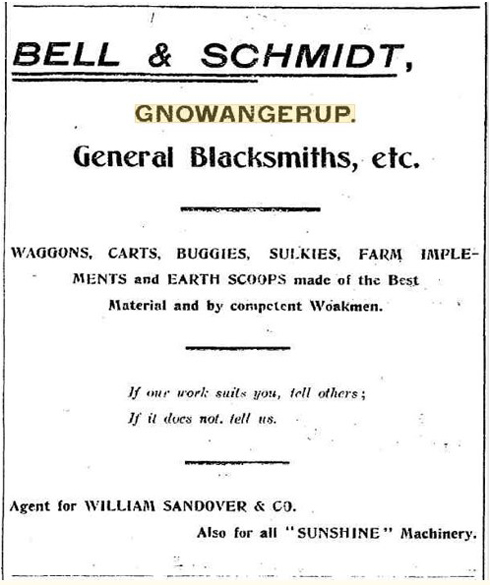
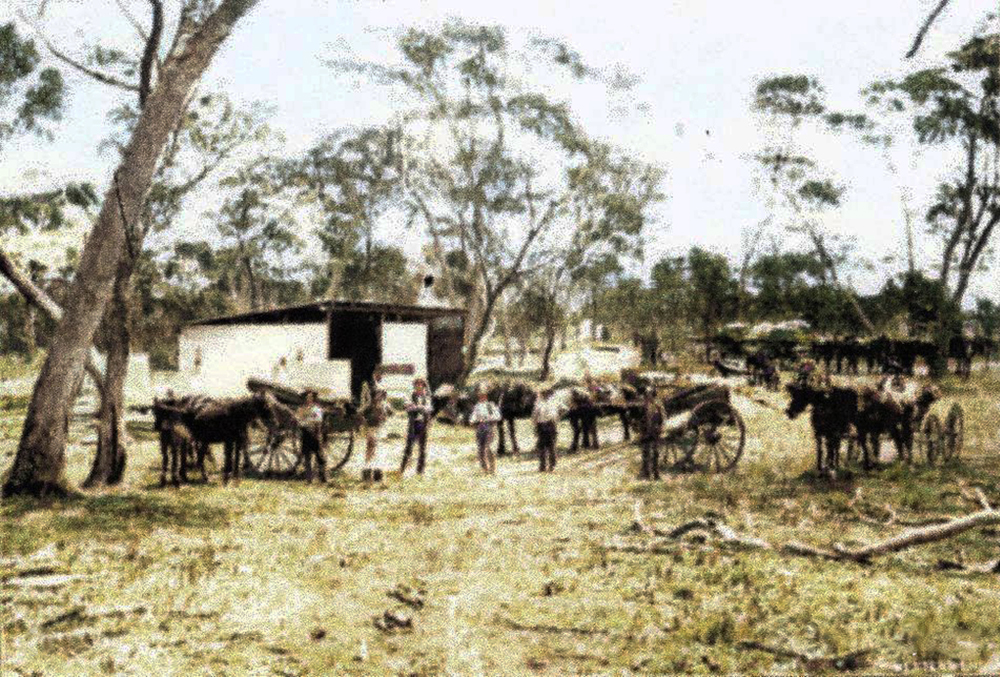
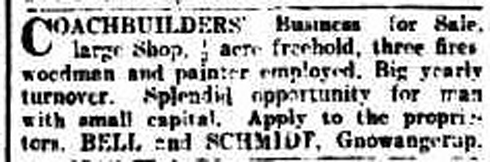
BELL & SCHMIDT NEW In the 1800s and early 1900’s the blacksmith’s shop occupied a central place in the life of rural towns and farming districts.In many cases, such as at Gnowangerup, the blacksith was the first business to operate in the newly declared town. Blacksmiths shops were usually modest, practical buildings: simple timber frames clad with timber or preferably corrugated iron, and sited where they could be readily reached by locals. Their unpretentious exteriors belied the importance of the work within. The blacksmith shop in Gnowangerup was established by Mr James Bell & Mr Schmidt in 1908 The main building (Blacksmith Shop) was 50 x 25 ft (15.2m × 7.6m) and the Wheelwright's Shop was 25 ft × 25 ft (7.6m × 7.6m). Considered a large shop, it encompassed an acre of freehold land.The men maintained three fires and employed a ‘woodman’ and a painter. Stepping inside a typical blacksmith’s shop one would find a warm, noisy, and intensely practical workshop. Dominating the space was the forge — a large hearth or fire-pot fed with charcoal or coke — whose amber glow provided light as well as heat.
|
BELL & SCHMIDT ADVERT 1912 #1 |
|
A pair of hand-driven bellows stood ready to be worked to raise the temperature of the coals whenever a bar of iron needed to be made red hot. The anvil, a heavy iron block with a broad face and horn, occupied a central position; around it the blacksmith and any apprentices hammered out the shapes demanded by the day’s tasks. A water trough or quenching vat was kept to cool and temper newly shaped pieces and to maintain hot tools. Racks and benches held assorted hammers, tongs, chisels and other specialised implements, while raw material — bars and plates of iron, nails, and spare horse-shoes — were stacked for use. Shoeing horses and repairing cart wheels were the most visible and frequent services: well-fitted shoes kept transport animals and draught horses sound and productive for farm work and journeys. The blacksmith also repaired and fabricated the metal components of tools, wagons and agricultural implements — from axle repair and wheel-tying to the forging of plough-shares and hinges. When farmers arrived with a broken harness, a damaged gate, or a worn mould board, they relied on the blacksmith’s skill to restore essential equipment. Blacksmiths also undertook custom metalwork: crafting brackets, bolts, and decorative ironwork for buildings and homesteads or producing one-off pieces required by tradespeople and householders. |
|
|
|
Because of this technical versatility, the blacksmith was regarded as a vital community figure. More than a craftsman, he was a problem-solver — capable of improvising solutions from raw metal and a small set of tools. In smaller settlements, blacksmiths often combined their forging work with other mechanical tasks and sometimes undertook rudimentary vehicle repairs or metal-working jobs that today would fall to several specialist trades. The blacksmith’s earnings were steady and his business an essential for the local economy.Socially, the shop was also a meeting place. Farmers, drovers and townsfolk could linger between errands to exchange news, discuss markets, or arrange future work.
BUSINESS FOR SALE 22nd Feb 1913 #3 |
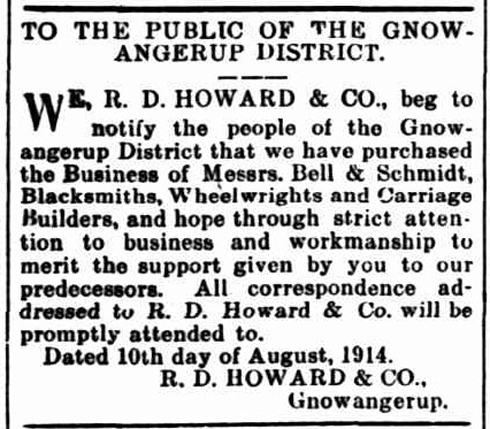
NEW OWNERS 10th August1914 #4
|
|
|
|
Every endeavour has been made to accurately record the details however if you would like to provide additional images and/or newer information we are pleased to update the details on this site. Please use CONTACT at the top of this page to email us. We appreciate your involvement in recording the history of our area.
|
|
References: Article: Image: 1 Gnowangerup Star Newspaper
Copyright : Gordon Freegard 2023 - 2025 |